A day in Olney.
When I wanted to spend a day catching up with one of my favourite people, where better to do it but the town where we both grew-up?
Olney is a lovely market town in Buckinghamshire and as is often the case, if you live somewhere, it’s hard to think of it as anywhere but your home town, rather than a tourist attraction or a place to go for the day. Well people, we are wrong! After spending a lovely day in Olney last week, I can honestly say that I am very lucky to have such a lovely place to visit within easy distance, and I bet if you all take a look at your local area, you’ll find the same.

Olney is a lovely place to stroll around, taking in the old buildings, many with a history of their own, plus admiring the widest high street in England. There are plenty of shops to browse (more about these later) and places to eat, so you really can make a good afternoon of it.
Before I forget, I should mention that parking in Olney is FREE and there are plenty of spaces on the high street, in the market place and at the Rugby Club (follow the signs on the high street).
FACT ALERT!
Olney (the locals say this with a silent L) is famous for a couple of things throughout the world!
The Pancake Race – Olney is where the original pancake race was first run hundreds of years ago. This race is now copied throughout the UK on Shrove Tuesday and in 1950 the race became an International event when the town of Liberal in Kansas, USA, after seeing some photos of the event, set-up a similar custom. The two towns now compete annually and prizes are exchanged. You can find out more on the link above.
Amazing Grace – John Newton, a resident of Olney, is said to have written the words to the hymn ‘Amazing Grace’ after his conversion to Christianity. This song is famous world-wide and still sung to this day.
John Newton was very good friends with William Cowper after meeting at a funeral and moving to Olney on his recommendation, and William himself was and still is a renown poet and letter writer.
Where better to start our day out than at the Cowper and Newton Museum in the centre of town? What made this idea even better is that my friend’s Dad volunteers at the museum, so we got our own private tour!


Orchard Rise (the name of the house) is where William Cowper and Mary Unwin lived from 1768 to 1786, and the museum was founded in 1900. It’s easy to find, being on the corner of the market place (not square – ask a local why!) and the entrance leads straight into their small shop selling items relevant to the museum and town. After paying our entrance fee of £6.00 (the museum is privately funded by Friends and people who visit) we were each given an annual pass so that we could visit as many times as we liked over the next 12 months.
Roger (our trusty guide) showed us through to the courtyard that separates the two buildings that make up the museum. The whole time I lived in Olney (about 20 years) I have never noticed that it is two buildings! From the front it looks like one, but it is actually two buildings – one side where William Cowper (pronounced Cooper) lived and the other side was for his servants.
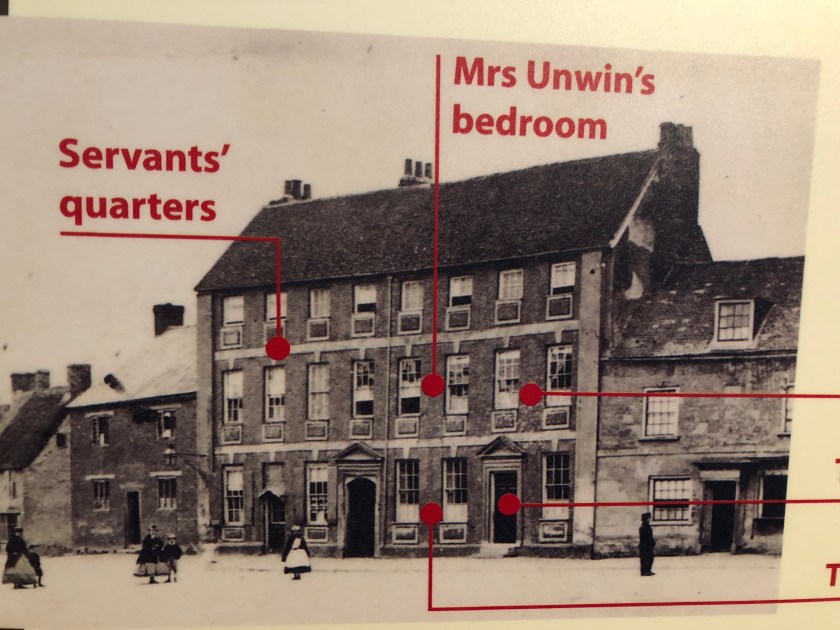
We first took a look around the gardens and learnt that the land behind the museum was bought so that there was an easy way for John and William to get to each other’s houses, without having to go into the busy high street and market place.


The stone work you can see in one of the photos above used to be above a building in Olney, but is now placed at the museum. Another piece of Olney history is the local lace trade that flourished in the 1900s and before, and still continues today in small lace making groups and in the beautiful examples you can find in private houses and at the museum.
(Interesting personal fact – I used to go to lace making classes in Olney that actually took place at the museum in what is now where you pay to get in! Shows how much kids don’t pay attention to their surroundings!)
If you look closely at the image, you’ll see that it depicts the equipment needed to be able to make lace. The left-hand side shows how the cotton was spun for the thread, the right-hand side shows the bobbins that were needed to make the lace and the centre shows how the ladies used to light their room effectively to be able to continue to make lace in the dark evenings, before electricity was available. They would place a candle is the centre of the stand and then surround this by glass balls of water to reflect the light more effectively. You can also see at the bottom the small bags that would have been filled with warm ashes from the fire to keep their feet warm.
You can find more about the art of lace-making here or visit the museum where you can find out more about the history and see some of the beautiful work created by the residents of Olney past and present. There is also a lovely walk you can do around the town, seeing all of the important buildings used within the industry. You can find this here on the Olney and District Historical website.
What do you think this is?
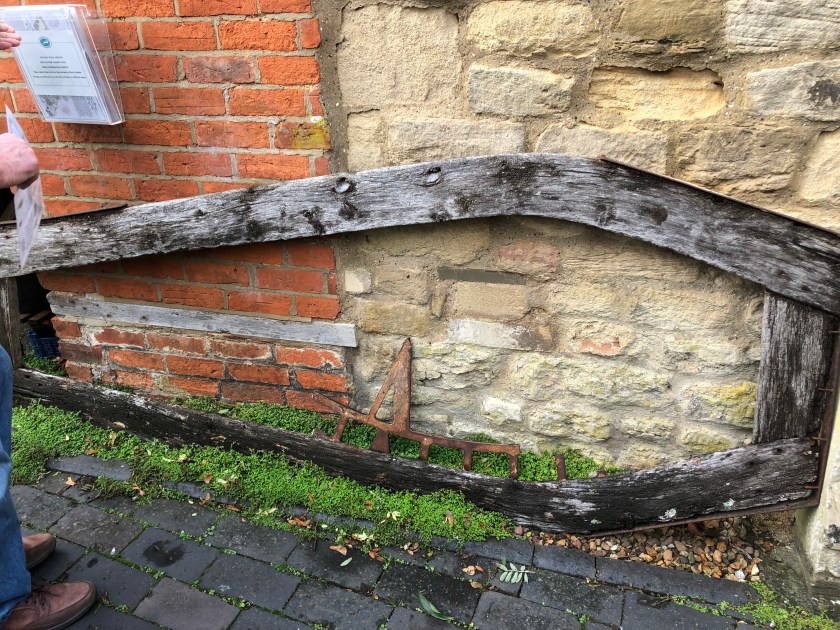
You’d be forgiven for thinking it’s a coffin or the bottom of a boat, but it’s actually a template for grave diggers to use when preparing the ground for a coffin.
Making our way further into the gardens (all looked after by the volunteers) we came across the famous Summer House. Originally a smoking retreat as smoking indoors wasn’t allowed, the house also became a writing retreat for William and friends. When you visit and take a look inside, you’ll be surprised to see lots of graffiti inside and will probably think the same as me ‘Bloody kids’! But actually, the graffiti was written around 1800 when the summer house was first opened to visitors after William’s death and was seen as a literary shrine. There are a few funny stories attached to the graffiti, so well worth a visit to see what it’s all about!


Making our way inside, we entered the servant’s side of the house and we were in the kitchen area and could see where it was believed William’s pet hares ran between the rooms!


Looking at the huge family tree on the wall, you can see that William is distantly related to Anne Boleyn and walking through the rooms, you get to see many personal items owned and used by William, including his writing desk, which is also seen in this portrait of him.


You can also see the ‘Sofa’ that William Cowper wrote about in his poem ‘The Task’ and can find out more about this and his other works here.


Making our way upstairs we came to a room dedicated to the horrifying history of Slavery in the UK. Over a period of 300 years, starting in the early 1500s, more than 12 MILLION Africans were captured and transported across the Atlantic to work as slaves in the Americas. By 1700, Britain was the largest slave trading nation.
Take a moment to take that in. 12 MILLION people were taken from their homes and families to be sold as produce to other humans who bought them, put them to work and in the large majority mis-treated them and made their lives a misery. Mothers were separated from their children, men from their wives and all because of the colour of their skin. Unbelievable.
The room only covers the history very briefly but is relevant as John Newton was the Captain of a slave ship in 1750. He led three voyages and was responsible for the forced relocation of 511 Africans. There was an example of a slave ship and the way the humans were treated, as well as an example of the space they were provided for voyages that lasted weeks. To see the conditions they were forced to live in was sobering.
John Newton changed his ways after being caught in a bad storm at sea during a crossing and praying that if he survived it, he would change his ways. In later life he reflected, ‘It will always be a subject of humiliating reflection to me, that I was, once an active instrument in a business at which my heart now shudders.’


The tour took us through some more rooms that had some lovely examples of how people dressed and how William and Mrs Unwin lived, as well as a room dedicated to lace making.


Here’s a photo of Roger outside the museum after his brilliant tour. Roger and his family (therefore my friend) have a long and fascinating connection with Olney and the surrounding villages and many of his relatives have lived and worked around here. Hopefully my friend is going to write a little bit about this for my blog…..
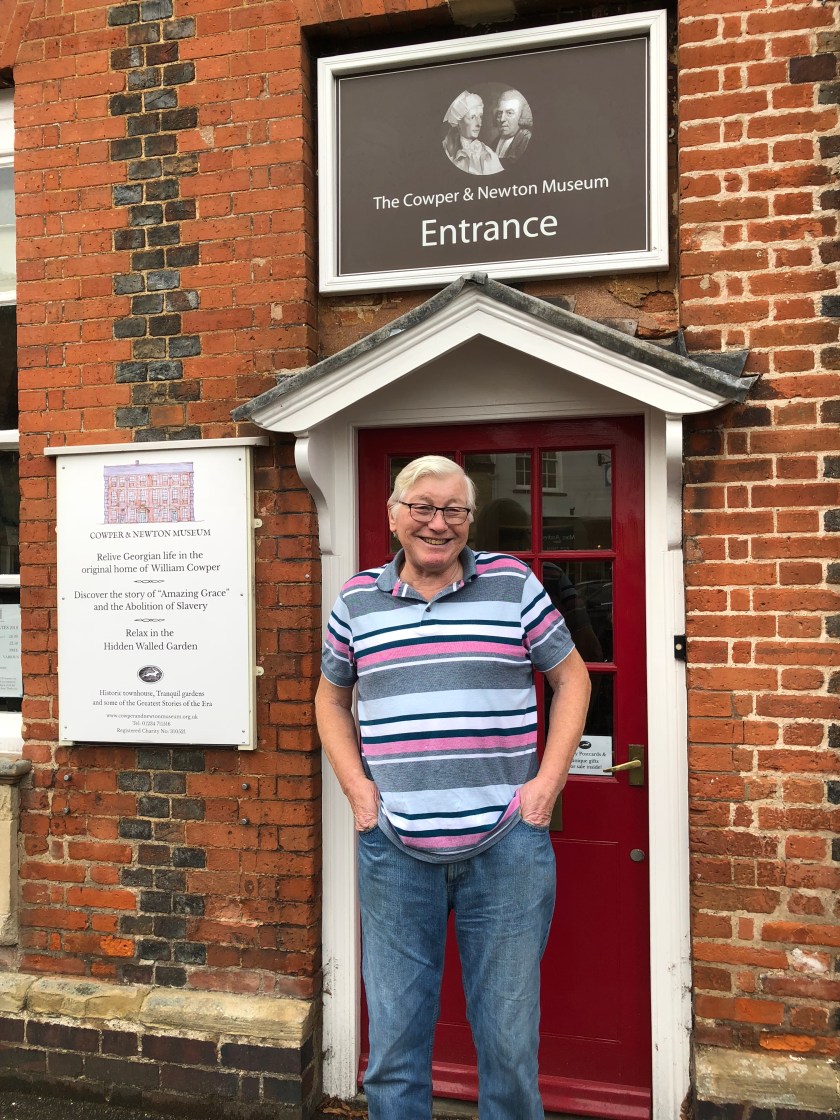
Thank you Roger and the museum for a brilliant couple of hours. I learnt a lot and enjoyed hearing about the history of my hometown.
We spent the next couple of hours happily looking around the wonderful shops around the market place and along the high street. Lots of antiques to look at in the Olney Antiques Centre and My Little Vintage, as well as lovely homewares in The Nest at No9 and a brilliant Oxfam book shop where I bought a book on the Underground Railroad, inspired by what I had begun to learn about slavery at the museum. You can read more about the shops on the Olney website.


Here are some photos of Olney for you to enjoy and be inspired to visit by!


Our final stop was to Teapots of Olney, for a simple afternoon tea. Friendly staff and delicious food, plus lots of photos of Olney through the years and a lovely cuckoo clock to enjoy – well worth a visit.


I really enjoyed being a tourist in my home town and recommend, not only a visit to beautiful Olney, but for you all to take a look at what’s around you and enjoy a day out closer to home and really see what is right on your doorstep.
Visit Olney – https://www.visitolney.com/
I would love to hear from anyone who visits!
 One (wo)man and her (cara)van
Why isn’t it Market Square then?
LikeLike
I knew it would be you who asked! Basically because it isn’t a square! There are always arguments going on with locals on the Olney Facebook page about it as lots of people (myself included) have grown-up calling it the market square, but it is, in fact, an oblong I believe or even a triangle? I’m sure someone will put me right! Thank you for reading x
LikeLike
Fantastic write up about our day out at home my fabulous friend- loved spending the day with you #staycation
LikeLike
Loved it too! Will plan another soon x
LikeLike